Friday, August 24, 2012

Review: Les Uns et Les Autres aka Bolero 1981 - an epic about our daily lives


"There are only two or three human stories and they go on repeating themselves as if they had never happened before…"

Les Uns et Les Autres is one movie worth watching. Again and again. From the first scene till the last there is one big circle of events, people and lives. At just under three hours hours, Les Une et Les Autres is a long movie but these three hours are amongst the best three hours I have ever spent on cinema.  The story of Les Uns et Les Autres  may seem as if it is about artists being herded into war; though soon we come to realise the reality, that it is never the one soldier who fights the war against his state's enemy but his entire family which finds itself at war, with cruel fate. For what else is it to the mother of an infant when her husband is executed for trying to escape his POW camp a few hours before the official end of hostilities. Or when middle aged parents are told the heart wrenching news of the death of their sons in combat even as across the street their neighbour is welcomed back home from the war by his wife and children singing to the tune of a jazz orchestra. Incredulous juxtapositioning? Perhaps to the inhabitants of today's world, secure as it is from any large scale armed conflicts between nations, yes. But not false. And it certainly can and does happen.


Music is the binding thread in Les Uns et Les Autres. It is the story of four families and their friends over the course of 25 odd years. Three of the four families, one each from USA, France and Germany , are connected to playing music and the fourth, a Russian family, is associated with dancing to music. The characters (and their children and children's children) over the decades keeping walking in and out of each other's lives usually without anyone realizing their mutual connections from the past. And perhaps that is how it is in real life too and if it is or it isn't, how will we ever know,  after all , we don't realize the connections we share with other random people criss crossing our lives, because once we do realize the connection, they stop being random people. Ancient friendships which stains under the weight of things kept unsaid, and angry recriminations erupting at the wrong time, only to be bolstered by the feeling of camaraderie and bitter sweet memories. A badge of honour from the wrong man which will forever be an albatross around one's neck. People who know what to do to get by when the times change; who know how to bet on the winning horse every time but only for so so long for fortune is just one giant Ferris wheel. The stories of the War generation give way to the stories of the 60s generation and yet the stories are essentially the same  ...as if they had never happened before… the Ferris wheel keeps coming back. Even the ending of the movie comes back to the beginning.


One thing  I liked about the movie is that certain key scenes involve the supporting cast. In fact there are no protagonists, everyone who is shown in the movie has a significant role to play in some way just as in real life everyone is equally important, in a way. Comic relief is provided in the form of the two teenage brothers who can not give up on even the smallest of oppourtunities to throw punches at each other (in good humour) though ultimately there is a tragedy in this as well. The overall sense is one of tragedy. The last one hour moves quite quickly. Time loses its continuum and leaps back and forth, some scenes are genuinely confusing as the same actors play both the parent and the child or the grand parent and the child. This technique of narration takes some getting used to but fits perfectly into the overall "feel" of the movie. Some pretty solid editing manages to hold everything together.


There is minimal use of dialogues. Most of the narrative progression is through visuals and not through dialogues. Significant events, such as courtship and marriages, come to happen over the course of a few seconds. Yet, there a voice which does narrate certain events which are not shown to have passed but lead to other events in the chronological progression of the script. The narrative is mostly linear. Some of the dialogues are truly inspirational. Sample this one; "No man who has known war could ever start another. Those who start wars must know no friends nor lovers. Must be their way to get revenge on those who are happy."


Claude Lelouche's direction is fantastic. The way the focus moves from the key characters in the foreground to the supporting cast in the distant background brings out the significance those supporting roles have for the movie. Cinematography is quite good. Fantastic use of zooms to take the viewer inside the thoughts of the character on scree and at other times to fix the character inside the larger frame of things. My favourite such scene is the mental asylum scene shot through the window in which the camera follows a middle aged son as he walks towards his old and mentally ailing estranged mother siting alone on a solitary bench in the light of the setting sun. I loved the winding staircases which keep cropping up throughout the movie and the extremely wide angled fast moving circular shots of these winding staircases. Long shots where the camera follows the actor are also well suited to the overall aura of the story.  I liked everyone's performance in Les Uns et Les Autres, Geraldine Chaplin in particular has acted quite well. I felt she did a great job in Doctor Zhivago too. Actually everyone's dished out great performances.

I have added another great title to my list of all time favourite movies and I am sure Les Uns et Les Autres will touch every one who see it in one way or another.


And the dancing...did I mention the phenomenal dancing? Check out Jorge Donn move to Maurice Ravel's  unforgettable Bolero.


Oh! An there's even a glimpse of Sharon Stone thrown in for good measure.


Saturday, August 18, 2012

The Statistics of Climate Change - A Case Analysis of Dr James Hansens 2012 Paper

The Statistics of Climate Change - A Case Analysis of Dr James Hansen's 2012 Paper

Climate change is such a hotly debated topic that almost everyone has an opinion on it and even to not have an opinion ("I just don't know") is a valid opinion as many believe that we still do not have enough data to swing the decision in either side's favour.

The phenomenally controversial head of the Goddard Institute of Space Studies of NASA and noted Anthropogenic Global Warming proponent, Dr James Hansen has published a paper called Perception of Climate Change, in a scientific journal called Proceedings of the National Academy of Sciences, in which he gives statistical data for temperature changes over the last six decades in the Northern Hemisphere of the Earth. Using this data, Dr Hansen concludes that the Earth has been getting much warmer and that the evidence is incontrovertible. Further he also claims that extreme weather situations have become much more common than earlier. The Economist has carried a story on this study and this is where I first read about the study.


The data graph of the study given in The Economist


Description of the Graph :

  • The data plotted pertains to temperature readings during the months from June to August for six decades starting from 1950s down to 2011 for the Northern Hemisphere.
  • The data plotted is relative data not absolute data. This has been done to facilitate better comparisons.
  • The reference curve (given in Dark Brown) comprises the average temperature values from 1951 to 1980; this builds a base with which to compare the temperature variations in each of the six decades. 1951-80 has been taken as a reference because this time period is long enough to build a normalized data range.
  • 0 marked on the X axis (standard deviation) is the average temperature for the reference curve (1951-1980), which obviously has a sstandard deviation value of 0.
  • The data for each decade is Normally Distributed and hence the peak frequency value for each decade coincides with the Mean(Average)/Median/Mode temperature of that decade. Further the 68-95-99.7 rule holds wherein 68% of the temperature values for any decade fall within 1 standard deviation on either side of the Mean temperature value, 95% temperature values fall within 2 standard deviations on either side of the Mean and 99.7% fall within 3 standard deviation.
  • Dr Hansen describes an "Extreme Condition" as a temperature value which falls beyond 3 standard deviations from the Mean ie beyond 99.7% of the temperature range. This obviously has to be an absolute limit because uncomfortable or harmful weather is mostly an absolute figure in the short run. In the long run, life could perhaps adapt to the permanent changes but then a few decades can not be considered enough for adapting to these extreme conditions. These Extreme Conditions are perhaps the most important part of the data, from Dr Hansen's point of view.
Conclusions from the Graph:
  • The data plotted clearly shows an increase in the average Summer temperature with each new decade. This can be observed from a right shift, along the X axis, of the Mean temperature value for Reach successive decade as shown by the peak of the Normal Curve for that decade. The Reference Curve's Mean temperature value moves from 0 to 1 for 2001-2011.
  • The data also shows a much broader range and hence variation of temperatures for each successive decade. This can be seen from the increasingly flattening Normal Distribution. As one moves from one decade to the next, the frequency for the temperature starts to spread out over a wider range which shows up as a lower and flatter curve than the one for the previous decade. This means that since 1951 temperatures have been fluctuating as an ever increasingly pace. This large variation translates into lesser and lesser equitable climate, lesser reliable weather and could mean greater stress on crops and businesses and more discomfort for people, animals, plants and vegetation in general. The number of recordings for the Mean temperature drops from 0.4 readings in the Reference Curve to 0.3 in the 2001-2011 curve.
  • The cases of Extreme Conditions in weather,as defined by Dr Hansen, were about 0.3% or less for the Reference Curve but for the 2001-2011 decade these were 6-8% or even more for the hot right side of the curve (though not so for the cold left side). This can be inferred from the right most part of the 2001-2011 Normal Curve, representing perhaps 1.5 standard deviations which  has crept in the zone of Extreme Heat. Hence there are 6-8% temperature values for the decade of 2001-11 which fall into the category of Extreme Heat. Hot weather extremities are clearly on the rise as well.


Positive Attributes of the Study:


  • The GISS data is all encompassing. Data for the entire Earth has been collected. This is not a sample survey, this is a reading of the entire data universe (the entire Earth in this case). Climate is always a global phenomenon (as opposed to weather) and that is why climate change can only be talked about on a global scale. Rising temperatures in one or many parts of the globe will always be concomitant with other related phenomena in other parts of the globe. This universality of data is one of the two big advantages of this study. On the flip side however, only the data for the Summer months in the Northern Hemisphere has been actually plotted in the Normal Curves (see the Doubts section below for more details)


  • Data plotted is actually recorded data, not future projected data. There are no modelling results used here, no assumptions to validate or disprove. This is all genuine and historic data, hence the readings, at least, are unassailable. This, absolute independence from projected data to my mind is the the other big advantage of this study.
  • This data analysis has been accepted by a leading scientific journal called Proceedings of the National Academy of Sciences and this gives it some serious credibility, though, it is no guarantee of the water tightness of the analysis.


Doubts over the Study

Statistics have to earn our trust. We can't give it away for free to them. They have to be able to withstand our scrutiny. And this applies more so to statistics we want should be true, the ones which prove something we hold dear. Or else, suddenly, we might find ourselves betrayed by our own hasty acceptance of data we want to believe in.
Data Doubts


  • Is a period of 60 years enough to provide data for climate change? What is the accepted time  span amongst the scientific community for talking about climate rather than weather, especially when discussing long series temperature changes? In fact, is there is any consensus at all about the time span? What results do we get when we analyse the data for the last 100 years (provided we have reliable global temperature data going back that far).


  • Why only plot the data for the Northern Hemisphere and not for the Southern Hemisphere? Perhaps one explanation can be that this has been done in order to facilitate a true comparison. Summer in the Northern Hemisphere extends from June to August, whereas at this time the Southern Hemisphere usually experiences Winter. Hence in order to compare apples with apples, one needs to select the Summer months' data from one hemisphere ie compare June-August data for each year for the Northern Hemisphere and compare December-March data for each year for the Southern Hemisphere. The temperature data for the Summer months in the Southern Hemisphere should be plotted separately as a Normal Distribution for a truly global analysis. If there is indeed global warming taking place then the data for the Southern Summer months will further support this conclusion because, again, climate is a global phenomenon.


Correlation and Causation

Although, in this scientific paper Dr Hansen has not made any claims about the causes of this clear rise in global temperatures, he is a vociferous advocate of Anthropogenic Global Warming (read human induced global warming) and will place this data analysis in that context.

I think the single most important caveat for anyone looking at statistics, be they of weekly milk prices for one's household budget or climate change figures, is to not confuse correlation with causation. Sympathetic movement of two things does not imply a dependency relationship between those two things. Recently Krishnamurthy V Subramanian of the Indian School of Business has written a very lucid and meaningful article on the difference between correlation and causation. It can be accessed here.

I believe that climate change is being brought about human actions.I don't know this but I believe it. I am constantly trying to find ways to reduce my carbon footprint. However I do not wish to be slotted into either of the two opposing camps.

However instead of going into why I believe this I would like to dwell on some questions come to my mind based only on rationale. The answers to these questions will need more data and analysis but once answered they will perhaps help convert my belief into my knowledge and certainly aid policy makers and businesses to come to terms with the reality of our economic activities (again provided these questions are answered).

These questions directly address the correlation and causation problem for this study on climate change. Answering these could help convert any correlation between greenhouse emissions and climate change into a casual relationship and further even establish the direction of the relationship.

  • How are we certain that human action is causing climate change? Evidence seems to suggest that for all of the previous climate changes in the 4.5 odd billion years long history of our planet, humans have not even been around to witness them, let alone influence them. 
  • Other causes need to be eliminated (though I personally do not give much credence to most of them) such as increased Solar activity, fundamental geo-changes, inner core dynamics etcetera.
  • Perhaps this time, that we are living in, is the inflection point of a very long run millions of years long climate cycle and hence this sudden acceleration might be a regular thing before such a cycle enter the next phase.
  • Could it be that in the absence of greenhouse gas emissions temperatures would drop rapidly? Is human activity somehow forestalling the next Ice Age, is this delaying of the Ice Age somehow better (but at what cost)? Perhaps there are some human activities which are masking the effect of excess CO2 (such as smoke emission which cools as opposed to CO2 emission which warms)


The data above clearly points to increasing weather temperatures in the Northern Hemisphere since the 1950s. Further heat extremities are also rising, fast. But I do need to clear my reservations, as given above in the Data Doubts section, before I can whole heatedly embrace the analysis. Perhaps within the next few years even more conclusive and exhaustive statistical studies on climate change will be carried. I eagerly await that time.


To know more about:

The Economist's story on the study published by Dr Hansen

Climate change Pro Anthropogenic Global Warming
New Scientist
NASA on climate change
Earth Observatory's global temperature data going back 2500 years
And this page which gives human greenhouse gas emission data alongside

Anti-Anthropogenic Global Warming
Telegraph
Skeptical Science
Wikipedia


Normal Distribution in Statistics
Cliff Notes
Stat Trek


Meanwhile, here in Delhi.......it's getting hotter and drier and more erratic........please ignore, as this is anecdotal evidence and does not make for good statistics ;)

Thursday, July 19, 2012

Dastangoi Perfomance - Dastan e Chouboli

My Recording of a Dastangoi Performance of Dastan e Chouboli

I had the good fortune of attending a very entertaining and engaging Dastangoi performance of  Shri Vijaydan Detha's Rajasthani folk tale: Dastan e Chouboli in Feb 2012. The performers were Danish Husain and Mahmood Farooqui and the performance was held at Epicentre, Gurgaon.

I had decided to shot this performance as my first-ever video. Apart from the learning I gained in shooting and editing I also gained hand on experience with concurrent sound recording (a tough job indeed).

Camera: Nikon D7000
Quality: Full HD 1080 29fps
Run Time: 68 minutes+
Mic: Shortgun mic mounted on camera body


This performance is based on a great Rajasthani folk tale by Shri Vijaydan Detha. You can learn more about Princess Chouboli and her vow of silence here at Katha's website which have published a fantastic cloth bound two volume translation of the Chouboli stories.

I love stories and Dastangoi is a great traditional Indian form of story telling. Other than the traditional Dastangoi tales, these days one can see Dastangoi performances based on modern themes as well.

You can read more about the great Dastangoi art tradition here at the Dastangoi blog and at the Facebook page to keep updated about Dastangoi events you may like to attend.

This reminds me I should start reading that copy of Bagh O Bahar I've had with me since the beginning of time...

Wednesday, January 25, 2012

List of the Best Virtual Panoramas / Virtual Tours / 360 degrees Views


List of the Best Panoramas / Virtual Tours / 360 degrees Views

Virtual panoramas are the perfect union of excellent locations, brilliant photography and cutting edge technology all of which come together to deliver a very high quality art experience. Panoramas transcend border and immigration lines, they offer a passage into our beautiful and varied world. The thing about panoramas is that they can not be viewed in still images of in books; virtual panoramas are a visual art form which can only be experienced on a computer screen or a television. Ultimately though despite all the technology these panoramas and tours can not replace the actual experience. They are meant to give a glimpse and to introduce, to help one decide to go to the actual site or to help one reminisce. The real experience is not just about that one building or site but about the journey to that place, they people and the culture and one's own but happy existence in that experience. But panoramas are beautiful nonetheless. And I love wasting hours and hours going over them.

Just click on the banner images below to go to the websites for these tours.


Suleymaniye Mosque Virtual Walking Tour Istanbul by Saudi Aramco.  My first virtual panorama and also one of my favourties. The Suleymaniye panorama is actually a part of a virtual tour of the entire mosque complex. Having seen the Suleymaniye in real life I can tell you that this virtual tour is very good and does provide an excellent simulation experience. The Istanbul skyline is so real, I almost felt like being back there.  My favourite scene is definately Scene 5: Minaret 1, for the stupendous Summer afternoon view of the Istanbul skyline all the way down to the Galat bridge and Ayasofya. And for the azaan, the call to prayer, mixed with the bazaar sounds in the background of the scene; so hypnotic for me that I often revisit this virtual walking just to hear that azaan on a never-ending loop. Make sure you check out all of the detailed interior scenes as well. Even while visiting the Suleymaniye I could not access most of the interior sections and certainly not the top of the minarets. I recommend viewing this virtual walking tour in full screen mode. There is a button to activate full screen at the bottom right hand side in every scene.

Some of the best photos of Suleymaniye Jami are to be found here 


Two more virtual walking tours by Saudi Aramaco are:

The Alhambra complex in the city of Granada. A really fantastic tour again but since I have never been there I can not speak of it in the same way as I do of the Suleymaniye tour. It is said to be one of the best historical sites in the world and this walking tour helped me understand why. I must read up more on this.


Site of the maginificent Dome of the Rock Mosque in Jerusalem. Possibly my all time favourite mosque and the third holiest site for Islam. Haraam Ash Shareef is where the First and Second Temple were located, supposed site of the near-sacrifice of Ishmael by his father Abraham. Jerusalem has always been very close to my heart though I have never been there. The sweeping views of Jerusalem from atop the mount, the wise angle shots of the Dome of the Rock are fantastic. You can read about the Dome of the Rock and the Haram Ash Shareef here. A virtual panorama I will keep coming back to for the rest of my life.


SISTINE CHAPEL BY THE VATICAN

Oh my God!!! Literally and in the most pious manner possible. This is a great gift by the Vatican to the net citizens of the world. A fantastic high resolution virtual panorama of the Sistine Chapel. Some time back I saw a BBC documentary called Divine Michelangelo in which one gets to see the back(and neck breaking) efforts Michelangelo had to make in order to fulfill his commission of painting the ceiling of the Sistine Chapel given to him by Pope Julius II. My aching cervical tremours in reverence at the mere thought of the years upon years Michelangelo spent painting the ceiling tilt-necked. And so naturally I was greatly intrigued to discover a virtual panorama of this object of power, faith, art, beauty and ever-lasting adoration.

The panorama of the chapel is phenomenal to say the least. It is such a great joy to see all of the paintings from the life of Christ on the walls and the scenes from the Old Testament on the ceiling. For someone like me, who enjoys Renaissance Art, this is a great treat. The level of detail really wins the day. And, I did not know that the floor of the Sistine Chapel was so beautiful. I suppose the floor gets sidelined, crowded out by the magnificence of the paintings on the walls and the ceiling. But then this is what panoramas are about; they let one view and observe the entire scene in complete serenity and patience. Do give it a deko.


Paris 26 Gigapixels by the triumvirate of Kolor, Arnaud Frich and Martin Loyer. It's a bright sunny day in Paris and there are plenty of sights to see. There is the Seine, the Sacre-Coeur, Notre Dame, L'Arc de Triomphe and a torrential rainstorm of painful memories of having repeated failed at le langue de francais. This is a very clean, purposeful and highly interactive panorma, though it is not a true-drum-barrel-back to where you started from kind of panorama as there are hard stops at either ends of the panorama and one has to make one's way back in the direction one came from rather than just keep moving in 360 degree circles. Nevertheless it is not a major flaw and does not distract from the delights of this grand French madame. The photographer responsible for the Paris 26 Gigapixels panorama has many of his own extremely beautiful panoramas here. Arnaud Frich actually discusses how to make photographic panoramas on his blog here


London 80 Gigapixels by Jeffrey Martin. Be sure to click on the show landmarks button at the bottom right to really enjoy the panorama.
Battersea power station, Tate Modern, Tower Bridge, Hyde Park, St. John's Park and Buckingham Palace, the Gerkin, St. Paul's, Shakespeare's Globe, Westminster Abbey and Big Ben (can't seem Cromwell's statue though,oh well), and Nelson's Column, Trafalgar Square and the little eat on the corner where I had some fantastic sandwiches and coffee.Even Piccadilly Circus can be found with some effort and next to it can be seen the HMV store from where I bought my coy of the Jewel in The Crown.

Next to the show landmarks button is a take the tour button which seems like a good idea as well.

Can't see the Beehive, the mayor's office, HMS Belfast, the floating museum. No information has been given about what one is looking at unlike the much more interactive Paris 26 Gigapixel tour.
The weather is overcast, as it should be. Of course.


The natural beauty of the American continent is so appealing to me. From Alaska to Baja California Don Bain has captured it all and made good looking panoramas out of all of them.

Don Bain's focus is not on just presenting picture-prefect-postcard virtual panoramas but to communicate the impression of a whole region. Considering that Don has over 8000 fantastic virtual panoramas I'd say he's communicated the impressions of a lotta regions in their entirety. Hence the use of the term" Virtual Guidebook" by Don for his kind of coverage. It is overkill? Perhaps for some. Am I drooling over the prospect of exploring the Oregon Trail, the Wild West, the Pacific coast line littoral and the heartland of the American-Indian lore in Canada and the USA? You betcha bottom Dollar bill I am.

The man's effort has to be applauded. He has brought together his skill, experience and passion and made the best use of oppourtunity (the launch of Apple's Quick Time viewer for example) to serve a superbly delectable multi-course gourmet meal of the wondrous sights of the Western half of North America. Yummm. Don Bain has my unequivocal respect. Highly recommended.


UNESCO and J M Kaplan Fund have come together to prepare a database of major UNESCO identified sites across our planet. I visited just a few of the sites. Sana'a in Yemen is one of my favourites. I love the shades of Brown and White of Sana'a's ancient multistory houses. And of course that brings to mind the spice markets and the great Quran horde of Sana'a. It's a great endevour and I wish them the best.


Budapest 70 Gigapixels by 360 degrees is also a very good effort. Initially it gives a sense of too much hot air and no real action as most of the 360 degrees view is full of trees and foliage and the city of Budapest is just a few tiny buildings vomitted out somewhere on the horizon. The vantage point seems to be a hill in a forest nnear Budapest. However if one clicks on the photos of the landmarks given just below the panorama one immediately sees what the fuss is all about. The panorama zooms into those distant tiny buildings of Budapest and suddenly they don't look so tiny anymore. The photo resolution is really quite large and all the landmarks are clearly visible. Even atom sized churches built atop hills on the horizon become quite big once zoomed into. Budapest is really beautiful, the architecture is a love child of Ottoman and Austrian which has been brought up in an environment of classy aesthetics and art supreme. This panorama has succeeded at its purpose. I must visit Budapest.


The New 7 Wonders of the World by Panorama.dk 
VR (Virtual Reality) Panorama tours of the New 7 Wonders of the World. My favourite ones are of the Great Wall of China, Petra, Colosseum and Christ Reeder Rio.


Panoramas.dk does have some really nice 360 degree panoramas including one of the Great Mosque at Cordoba, the Eiffel Tower, Mount Everest, Sydney Opera House and scores of others. One of my favourites is the series on 4 Danish and Swedish churches from the middle ages which can be seen here  One can zoom in and see all the details of the murals, paintings, church ornaments, liturgical objects and of course of the interior architecture itself. It's as close as one can get to actually being inside these churches. Very well executed job.

Another fantastic one by panoramas.dk is the Grand Canyon panorama.


Check out their complete list of VR 360 degrees panoramas here http://www.panoramas.dk/archive.html


Library on Strahov Monastery Prague by 360 degrees.
This panorama holds the record for the largest indoor photo in the world.3000 individual photos, totaling up to a colossal 40,000 megapixels, were arranged and stitched together to achieve this feat. As a photographer I can appreciate how supremely difficult it must have been to manage to shot 3000 high quality shots in low light conditions. A great accomplishment.
Take a peek into a library going back hundreds of years, zoom in and read the titles of the books arranged in the shelves, marvel at the exquisitely executed art on the paneling and the ceiling and of course the fantastic wooden furniture. A bibliophile's delight.


Not one panorama but rather a series of 36 panoramas of the city of Bruges which provide an indept "visit Bruges" experience. The canals runnings through the city look really lovely and the lights reflecting in them with the dark Blue sky above make for some fantastic viewing.


Tallinn Virtual Panorama by 360 degrees. The port city of Tallinn is the largest city of Estonia in the Baltic littoral. This set of virtual panoramas is in the same vein as the previous one on Bruges. Excellent views from scores of vantages points all over the city and many of them aerial shots from atop towers and domes.


Alexander's own land: Macedonia. Again a series of very touristy virtual panoramas which showcase the best of the country. The site is rife with panoramas of ancient hilltops, idyllic islands, Orthodox churches, heroes from the Aegean (Alexander's the main man of course).

Sample this virtual panorama of a fantastic ancient Greek theatre here.


This appears to be a Russian site which encourages people to upload their own virtual panormas.Naturally most of the virtual panoramas listed are of places from within the erstwhile Soviet Union. My favourite one is called "In a cockpit at an abandoned airfield" which has the vantage point from within a decrepit MIG 21 (?)   fighter jet 's cockpit. It's just so tragic. Reminded me of a story I once read in a Granada magazine on an abandonned Soviet-era "science city". The virtual panorama can viewed here.


Arounder; now here's a website I love to love. Arounder.com is full of scores of really well made virtual panoramas of many major tourist attractions (including 2 space-tourism destinations: Mars and Moon, keeping a firm eye on the future aren't we). I think I would love to see each and every one of these virtual panoramas, not even one week panorama here; for not only are these really well done technically, the choice of destinations is also quite well thought out. In fact on Arounder.com the problem is one of plenty; it's not what to select out of the lot and see, but what to, sadly, leave unexplored in order to give attention to the greater "to see" group. Monaco, Ibiza, Tahiti here I come.


A nice community based website which acts a showcase platform for high quality virtual panoramas made by the members of the community. Though not all of these panoramas are not those of very famous landmarks but they do give an insight into the ordinary life and environment of others and as there is nothing ordinary about life or nature I find these panoramas very fascinating. I was especially curious about the Curious Cows of Bavaria.


Virtual Tours in Google Earth
360 Cities has teamed up with Google Earth to provide virtual panoramas and tours of hundreds of places all over our world. Google Earth is a software which lets one visit any coordinates on our planet. Though it is not browser based but it is a supremely powerful tool. And it is open to the user community for adding 3D models of buildings, photos of places, landmarks and virtual tours.

The 360 Cities virtual tours on Google Earth are sometimes made of photos and sometimes of CAD models. They start-off as these circular bubbles which one has to zoom in to. There are hundreds and hundreds of virtual tours on Google Earth which one can enter and walk-around in. They range from tours of cities such as London and Shiraz to tours of Tour De France and cycling venues in the alps to volcanoes in the Pacific to anything and everything. To more about Google Earth go here. Google Earth is one of my favourite softwares.

Go here to know more about 360 Cities tours in Google Earth.


There are many really great virtual panoramas on the web and I haven't listed them out here though they are in no way lesser than the ones already listed above. The ones I have mentioned are merely indicative of the fantastic world of virtual panoramas.


Make your own panoramas

http://www.panoguide.com/
http://www.panoramas.dk/panorama/index.html

Thursday, January 19, 2012

Daastaan - e - Amir Hamza and Hamzanama


A sketch I made quite a few years back, copied out from a miniature painting on Dasatan - e - Amir Hamza, an epic story of the trials and deeds of prophet Muhammad's uncle Hamza. All Islamic sources unanimously agree that the real Hamza idb Adb Al Muttalib, the Prophet's coeval uncle , died in the Battle of Uhud in 625 A.D. However Hamza's swashbuckling-hero-like qualities and the narratives of real journeys he may have made all over the Middle East, Iran, Turan and the Indian Sub-Continent have lived on in the tradition of Dasatan - e - Amir Hamza in Persian literature and other literatures which have a Persian influence.

This illustration shown above has been copied from one of the greatest illustrated books ever produced, the Hamzanama of Emperor Akbar. This book is a truly phenomenal piece of work. The 15 years long production of Akbar's Hamzanama is considered to be a seminal event in the history of Indian art as it initiated the radical propelling of the tradition of Mughal miniatures to the top echelons of world art. While on the Mughal subject,  it is interesting to note that the different Hamza epics frequently refers to Amir Hamza as Sahib - i - Qiraani, which means Lord of the Fortuitous Conjunction. This title was also used by Mughal chroniclers for their founder Timur. I have written a post on the titles used by Timur here. This takeover of Hamza's title by Timur or assigning of a common title to both personalities for reasons of providing an association is something which has always intrigued me.

Stories from Dastan - e - Amir Hamza are regularly performed on the Indian Sub-Continent and in South-East Asia by dastangoi performers and are quite popular with various groups of audience. Be sure to check out a Dastangoi performance of Dastan - e - Amir Hamza whenever you get an oppourtunity, it's worth it.
I didn't want to write much about the Dastan - e - Amir Hamza as it really is quite popular; I just wanted to share my love for a wonderful fantasy story. The following websites give a lot of information about this great epic:

Wikipedia on Dastan - e - Amir Hamza

Smithsonian Institution - Highly recommended, very beautiful and visual website which uses images from the original Hamzanama of Akbar to introduce the story. The illustration above is also on the introduction page of the Smithsonian Institution's website.

Victoria & Albert Museum holds Akbar's Hamzanama. This website gives some details of the book and also provides a glimpse of the great book.

An academic discussion on the format, size and nature of Akbar's Hamzanama. Here (website) and (pdf)

Tilsim - e - Hoshruba - Nice website on a late 19th century Urdu recasting of  Dastan - e - Amir Hamza by Indian writers who vastly expanded and changed the original premise of the Dastan. This work has been recently translated into English.

You can read more about the great Dastangoi art tradition here

And here's a fantastic Dastangoi performance I shot in Feb 2012


Saturday, October 22, 2011

It's official folks, we're a 7 billion strong family now


Many population based maps are available at this forum.

 
World Map (country size based on population figure) 
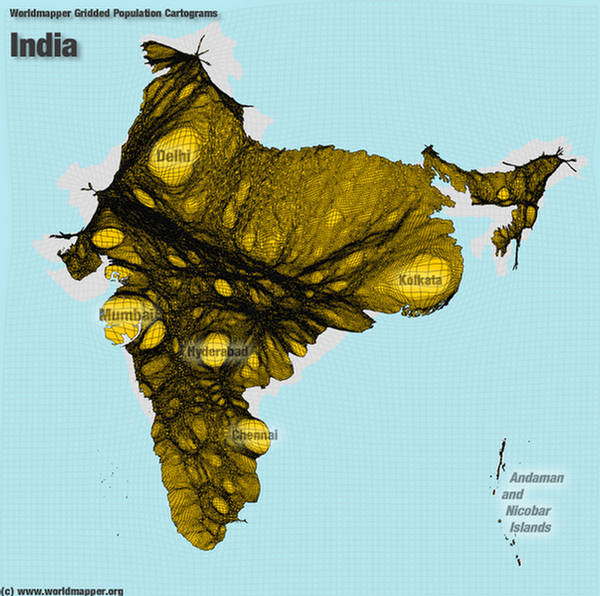
India Map (based on population figures), physical map given in faint outline.

Rajasthan, Gujarat, J&K, Uttranchal and most of the North East have shrunk drastically, whereas the metros have swelled up to hundreds of time of their physical size. Uttar Pradesh too has assumed a monstrous size.

Sunday, October 9, 2011

A Yukaghir girl writes a love letter / Semasiographic and Glottographic writing systems


A Yukaghir girl in love with a Yukaghir boy wrote him a letter. The Yukaghir are a North Eastern Siberian tribe who live by hunting and fishing. The letter is given below. This image constitutes the complete letter. Any guesses as to what it says?


A bit tough  to understand, isn' t it? The first I came across this letter, I couldn't understand any of it; in fact I only saw it as a drawing. But it is a letter indeed and what follows below is the explanation. I have highlighted the parts using various colours and then broken down the sequence of events into 9 frames only to explain the chain of thought. The actual letter is just the one colourless image shown above.


1. The writer of the letter, the Yukaghir girl, is the tree shape in Blue. We know she is a girl because she has plaited hair.


2.  The girl is in love with a Yukaghir boy, another tree shape, in Green. He is a boy as he doesn't have plaited hair. The letter is addressed to him.


3. The Yukaghir girl writes that she and the boy loved each other and this is depicted by the intermingling of their thoughts just above their tree point heads.


 4. The girl further writes that now the boy has left her for another girl, a Russian girl and started living with this Russian girl. The Russian girl is shown to the left of the boy in Red and they are shown together living under one roof (a step pyramid/tent-like structure over their heads). The Russian are ethnically, socially and culturally completely different from the Yukaghir and the writer shows this by drawing panniers on the Russian girl's skirts (which are absent from her own Yukaghir skirt). The Russian girl of course also has plaited hair as she too, is a girl.


5. The Yukaghir girl tells the  boy that the Russian girl has destroyed the relationship the Yukaghir boy and girl had earlier. This is depicted by the Russian girl's thoughts emanating from her head and cutting through the thoughts / love shared by the Yukaghir boy and girl earlier shown in figure 1.


 6. However the girl knows that all is not well between the Yukaghir boy and his Russian girl friend. This tension is depicted by crosses between the heads of the Yukaghir boy and Russian girl, highlighted in Red.


7. The girl also informs the boy that she is alone in her house and she is sad. Her sad state of mind is shown by the crosses drawn behind her own head. But she tells him that she still often thinks about him and wants to be with him. Her thoughts (shown emanating from her head in Blue) are still.... sort of....drifting towards him.


8. However there has been a development. She tells the boy that now another Yukaghir boy has started making advances towards her. These are shown by a rather persistent and focused squiggly emanating out of this new boy's head towards the girl.


9. The girl finally lets her ex lover know that if he wants to get back with her he should move immediately, before she gives into the advances made by the new Yukaghir boy and before her ex lover has children with the Russian girl. Two children are shown on the extreme left moving into the house of the Russian girl and the Yukaghir boy.


And so this is the interpreation of this love letter written by a grieving Yukaghir girl to her ex lover.


Amazing isn't it. Suddenly the letter seems so clear after the explanation. This letter is an example of a semasiographic system of writing. Semasiographic writing is when the writing/drawing represents the idea itself rather than any spoken words ie speech. The spoken words which are used everyday by the reader and the writer to communicate are not recorded in the written communication. The idea is recorded.

Actually we all deal with semasiographic writing everyday. Here are some examples:


Yup, these and many more semasiographic writings live all over our glottographic world. It is said that written mathematics is a very pure form of semasiographic writing.

Semasiographs are not the same as pictures. They are very much language based communication and are fluid in the sense that they can depict tenses and are very precise in interpretation to those who know how to read them, unlike pictures which are frozen and hence perhaps timeless and are also open to subjective interpretation. But most importantly any person using a semasiographic system will have to represent the same idea in the same way. handwriting differences notwithstanding. Whereas in a picture, there are many different ways to drawing the same idea, eg. a woman sitting next to a tree. This can be drawn in many different highly divergent ways. But the Yukaghir people must write the letter above in the same way. Here in lies the greatest difference between semasiographs and pictures.

This is an example of a picture. Perhaps a grieving lover draws this picture and sends to the one she grieves for. Or perhaps not. She may just be sleeping next to a tree. It is a painting.


However this is clear written semasiographic communication. It's a letter, not a pciture. Those familiar with the Yukaghir language know how to read this letter. Every Yukaghir who wants to represent the idea of this letter in writing will have to write the same letter. 


In both cases an idea is communicated. Both the painting and the semasiographic letter can be very precise if need be. But the two should not be confused.


Now the more prevalent writing system in today's world is not semasiographic but glottographic.This blog post is in English, which is an example of a glottographic system of writing. In a glottographic system the idea is not directly recorded in the communication. The spoken words which represent the idea are directly recorded. The idea to be communicated is not directly shown. Rather the written "speech" has to be read and then the idea becomes apparent. The Yukaghir people have actually now adopted the Cyrillic / Russian script for their languages after the Russification of North Eastern Siberia. Hence the Yukaghir languages have moved from a semasiographic system to a glottographic system of writing.

Obviously both semasiographic and glottographic systems have their respective advantages and disadvantages. Road signs, washing instructions, mathematics all if translated into glottographic writing would become extremely cumbersome and unwieldy. I think I would use neither exclusively if I had a choice. Both could be used in combination or different ones for different languages. That would be fun. And terribly confusing perhaps.In both the semasiographic system and the glottographic system, the writing, the language and the idea are being coded seamlessly and continuously but in different ways.

I came across this Yukaghir letter in a fantastic book on scripts called Writing Systems by Geoffery Sampson. It is a great book and I can re-read it many times. I recommend it to anyone who is interested in scripts and perhaps also in linguistics. Most of the ideas for this blog post have come to me directly from the 2nd chapter of this book. I think I love scripts even more than I love languages. I wished to write a much longer post but I am sure it too would have joined my list of long dead unfinished posts. Perhaps one day I will write on the symbiotic world of scripts and languages as well. God willing.


Know More:

Writing Systems by Geoffery Sampson
The Yukaghir
A study of writing by Ignace Gelb
Russification