Showing posts with label review. Show all posts

Thursday, June 4, 2015

Movies As Teachers For Learning The Urdu Language

I find movies to be fascinating tools for learning languages. Rarely are their dialogues cut from the same starched-stiff cloth as a Wren & Martin dinner jacket (unless the characterization requires it to be so). Far removed from the standard fare served in nearly every Learn-To-Converse-In book ever published movies talk about more interesting subjects like love, hurt, machinations, revenge, stillness, discovery, new experiences et al.  That is why movies are a great way to get a feel for the natural cadence and sounds of the language in question. They also serve as fantastic instructors for the appropriate use of idioms and phrases. Usually, they are also refulgent gateways to the culture of the peoples whose language one intends to learn, making the whole process of learning a language fun, real and memorable. Next to talking to native speakers of a language, this is one of my favourite ways of learning a new tongue.

To be sure, movie dialogues aren't the most kosher way of learning the grammar of a new language; they can be too quick, too softy whispered, too incomplete to always follow immaculately but then they more than make up by providing reference to context, diction and accent stress clues as aids to learning. Needless to say some very rudimentary vocabulary is essential to follow the dialogues but then grammar, especially syntax (word-order), can be picked up through the dialogues. One caveat here, if one's objective is to learn the 'Standard' register of a language (usually spotted in the newspapers, official reports and legal papers), then movies should not be one's primary source. They can at best only serve as an aid and should not be considered a substitute for a grammar compendium and formalized instructions.

Luckily, in this post-YouTube era most of us can easily access news, movies, talk shows, songs, regional language channels and even language instruction videos. Podcasts and internet streamed radio stations are also decent alternatives, though they come sans the visual experience. Another great feature one can make use of is 'subtitles'. While watching the movie online or through a software on your computer, simply turn on the subtitles in your target language for any movie and read the translations on the screen while listening to dialogues in the target language. YouTube even allows for slowing down the speed of the video playback (if this helps you).  However this may only work for those popular languages for which subtitles are commonly available. I often find myself turning on the subtitles in some language to English movies. In my books, this is a very special boon for language learners.

I think I first fell in love with this idea when as a kid, one lazy summer holiday afternoon, the VHS tape* of the Bollywood movie Amar Akbar Anthony I pushed into the VCR player turned out to be dubbed in Arabic.

Note to reader - a VHS tape is a magic device from a long gone era; often passed on with reverentially trembling hands from one generation to the next one, these antediluvian pen drives would be usually traded as if made of 18k gold on the local residential kids' exchanges.

Best Movies To Learn The Urdu Language

While earlier a majority of Bollywood movies had dialogues in the language called Hindustani (a slightly-shifted-towards-Urdu middle ground in the continuum between Urdu and Hindi) nowadays the dialogues are becoming more "street friendly". It is possible that Hindustani itself is changing rapidly and that these new dialogues merely reflect this change. Rather than as a chicken-egg problem, I see Hindustani and the language of Bollywood dialogues as part of a mutually enriching feedback mechanism.

Again, in order to extract the best from these Urdu movies, it is advisable for the learner to have a grasp of rudimentary Urdu/Hindustani vocabulary.

Click on the image for the trailer/song/movie snippet (if available). In no particular order of preference:

In Custody / Muhaafiz (1993)

 A movie by Merchant Ivory, based on a novel by Anita Desai, it is the story of a Hindi language professor's quest to keep alive his greatest love, Urdu, by recording for posterity the works of one of the last great, on his deathbed, poets of the Urdu language. The movie is beautifully shot and rife with visual metaphors of the demise of Urdu language. Brilliant ensemble cast of Shashi Kapoor, Om Puri, Shabana Azmi, Shushma Seth, Neena Gupta, Parikshit Sahni and Tinnu Anand, not one weak scene in this movie. Almost all of the ashaar featured in the movie are by Faiz Ahmed Faiz and some of the ghazals are by Behzad Lucknavi


This movie by Kamal Amrohi will be in nearly everyone's list of best romantic/tragic movies. Portraying the trials and tribulations of the life of a courtesan (very much on the same lines as Umrao Jaan), the tale ends with a heart wrenching twist of fate. Kamal Amrohi also wrote the dialogues for Mughal-E-Azam and wrote and directed Razai Sultana, two movies acclaimed for their scriptwriting amongst other things. The ghazals from Pakeezah are considered a part of modern Indian culture, especially the celebrated Chalte Chalte which was penned by Kaifi Azmi.


One of my favourite novels and movies. Rekha did an unbelievably masterful job with her Urdu diction for this movie; it was flawless. The second of courtesan stories in our list, the story is set in nearly decrepit Nawabi Awadh of the 1840s-1850s. Deeply touching and so memorable, the ghazals have been penned by Shahryar, a professor of Urdu at Aligarh muslim University. The only marginally light hearted melody in this movie, Zindagi Jab Bhi, which is about separation, gives you a sense of the tone of the rest of ghazals. And yet everyone, including me, loves them because they speak of the ever repeating story of our lives. Check out the novel by Mirza Ruswa, it's written in a very conversational and easy to access style. My English translation of the Urdu ghazal Yeh Kya Jagah Hai Doston from the movie is here. The entire script for the movie is in Nastaliq Urdu is available here.


This much vilified 2006 remake may be weak in terms of acting and song writing but it is absolutely top notch in terms of dialogues. Well researched, it is a must see for those who wish to take a detailed dekko into Luknavi Urdu, Adab and Tehezeb of the 1800s. Interestingly, Shabana Azmi played the role of Khanum Jaan (the brothel madam) in this 2006 version, while her mother, Shauqat Azmi played the same character in the 1981 version.


Satyajit Ray's film adaptation of Munishi Premchand's Urdu translation of Munshi Premchand's Hindi story on the abysmal decay of Indian elite society. Munishi Premchand often did self-translations of his works and he tells the story in very different ways in the two version: Hindi and Urdu, perhaps to give two slightly different messages to two segments of readers. Like Umrao Jaan, Shatranj Ke Khiladi too is set in Mutiny-era Lucknow. The movie follows two chess-mad nawaabs who, oblivious to all the political and personal tragedies around them, are obsessed with playing yet another game of chess. Superb thespian skills on display by Shabana Azmi, Saaed Jaffrey, Sanjeev Kumar, Amjad Khan and a cameo by some Jurassic-era chap called Richard Attenborough who keeps babbling about the Nawaab's Mutaa Wives :D  The entire script is available here in Nastaliq Urdu.


Probably a surprise addition to this list for most people. A nearly scene by scene copy of the 1957 hit, 12 Angry Men, this movie has no courtesans, no Mughal princes, no ghazals, no tehezeeb and no adab. But it does have loads and loads of very cleanly spoken simple Urdu dialogues, from amuman to maaqool shaks and everything in between. The dialogue does sound made up but then this isn't really a movie review. What works in favour of EkRuka Hua Faisla are a known plot, easy to follow dialogues and repeated use of many Urdu words and phrases. Most of the actors are seasoned theatre and film players which translates into good and measured Urdu diction.


I like Bobby Jasoos for its Deccani (Hyderabadi) Urdu. For a considerable time in its early history (fondly referred to as Nash-o-Numa) Urdu developed its own unique image as Rekhta in the courts and bazars of Deccan before taking on the Urdu glean we have come to know and love in Delhi and then in Lucknow. Up until the mid 1800s both the names Rekhta and Urdu were sometimes used interchangeably for the Urdu language; Mirza Ghalib in one of his shers observed رختے کے تم ھی نھیں ھو استاد غالب / کھتیں ھیں کھ اگلے زمانے میں یک میر تھا There is something very endearing and heart warming about Hyderabadi Urdu; I hope to gain a certain level of proficiency in speaking it. Bobby Jasoos is a fun film and makes for great dialogues.


A soul searching statement on the impact of partition on those who chose to stay back in India. Very few such movies have been made on the post-Independence era. The towering figure of Balraj Sahni leads a brilliant caste to deliver some of the most credible performances in India cinema. Kaifi Azmi and the great Ismat Chughtai wrote the screenplay and the story for Garm Hawa, which alone gives this a very high place in my echelon of Urdu movies. Great effort has been made to lend realism through the choice of different registers of Urdu speech (different vocabulary) for different characters based on their region, social class and age. The mesmerizing Sufi song Salim Chisti from Garm Hawa, along with Aaj Rang Hai from Junoon and Khawaja Mere Khawaja from Jodhaa Akbar, is my favourite BollywoodSufi piece.


Other movies which could have been part of this list but didn't make it (entirely due to my excellent skills in lethargy):


Two important points here: First, this is not an exhaustive list by any means. I keep discovering new and brilliant Urdu movies all the time. Second, I have extremely limited access to Pakistani movies and hence, sadly, that entire universe of Pakistani Urdu movies is untouched here. Hopefully, the latter problem will be addressed soon.

I fervently hope that people keep making such beautiful Urdu movies in the years to come.

If you have any doubts about any dialogues from any Urdu movie or want to learn / discuss more feel free to leave a comment and I shall get back to you.

Friday, August 24, 2012

Review: Les Uns et Les Autres aka Bolero 1981 - an epic about our daily lives


"There are only two or three human stories and they go on repeating themselves as if they had never happened before…"

Les Uns et Les Autres is one movie worth watching. Again and again. From the first scene till the last there is one big circle of events, people and lives. At just under three hours hours, Les Une et Les Autres is a long movie but these three hours are amongst the best three hours I have ever spent on cinema.  The story of Les Uns et Les Autres  may seem as if it is about artists being herded into war; though soon we come to realise the reality, that it is never the one soldier who fights the war against his state's enemy but his entire family which finds itself at war, with cruel fate. For what else is it to the mother of an infant when her husband is executed for trying to escape his POW camp a few hours before the official end of hostilities. Or when middle aged parents are told the heart wrenching news of the death of their sons in combat even as across the street their neighbour is welcomed back home from the war by his wife and children singing to the tune of a jazz orchestra. Incredulous juxtapositioning? Perhaps to the inhabitants of today's world, secure as it is from any large scale armed conflicts between nations, yes. But not false. And it certainly can and does happen.


Music is the binding thread in Les Uns et Les Autres. It is the story of four families and their friends over the course of 25 odd years. Three of the four families, one each from USA, France and Germany , are connected to playing music and the fourth, a Russian family, is associated with dancing to music. The characters (and their children and children's children) over the decades keeping walking in and out of each other's lives usually without anyone realizing their mutual connections from the past. And perhaps that is how it is in real life too and if it is or it isn't, how will we ever know,  after all , we don't realize the connections we share with other random people criss crossing our lives, because once we do realize the connection, they stop being random people. Ancient friendships which stains under the weight of things kept unsaid, and angry recriminations erupting at the wrong time, only to be bolstered by the feeling of camaraderie and bitter sweet memories. A badge of honour from the wrong man which will forever be an albatross around one's neck. People who know what to do to get by when the times change; who know how to bet on the winning horse every time but only for so so long for fortune is just one giant Ferris wheel. The stories of the War generation give way to the stories of the 60s generation and yet the stories are essentially the same  ...as if they had never happened before… the Ferris wheel keeps coming back. Even the ending of the movie comes back to the beginning.


One thing  I liked about the movie is that certain key scenes involve the supporting cast. In fact there are no protagonists, everyone who is shown in the movie has a significant role to play in some way just as in real life everyone is equally important, in a way. Comic relief is provided in the form of the two teenage brothers who can not give up on even the smallest of oppourtunities to throw punches at each other (in good humour) though ultimately there is a tragedy in this as well. The overall sense is one of tragedy. The last one hour moves quite quickly. Time loses its continuum and leaps back and forth, some scenes are genuinely confusing as the same actors play both the parent and the child or the grand parent and the child. This technique of narration takes some getting used to but fits perfectly into the overall "feel" of the movie. Some pretty solid editing manages to hold everything together.


There is minimal use of dialogues. Most of the narrative progression is through visuals and not through dialogues. Significant events, such as courtship and marriages, come to happen over the course of a few seconds. Yet, there a voice which does narrate certain events which are not shown to have passed but lead to other events in the chronological progression of the script. The narrative is mostly linear. Some of the dialogues are truly inspirational. Sample this one; "No man who has known war could ever start another. Those who start wars must know no friends nor lovers. Must be their way to get revenge on those who are happy."


Claude Lelouche's direction is fantastic. The way the focus moves from the key characters in the foreground to the supporting cast in the distant background brings out the significance those supporting roles have for the movie. Cinematography is quite good. Fantastic use of zooms to take the viewer inside the thoughts of the character on scree and at other times to fix the character inside the larger frame of things. My favourite such scene is the mental asylum scene shot through the window in which the camera follows a middle aged son as he walks towards his old and mentally ailing estranged mother siting alone on a solitary bench in the light of the setting sun. I loved the winding staircases which keep cropping up throughout the movie and the extremely wide angled fast moving circular shots of these winding staircases. Long shots where the camera follows the actor are also well suited to the overall aura of the story.  I liked everyone's performance in Les Uns et Les Autres, Geraldine Chaplin in particular has acted quite well. I felt she did a great job in Doctor Zhivago too. Actually everyone's dished out great performances.

I have added another great title to my list of all time favourite movies and I am sure Les Uns et Les Autres will touch every one who see it in one way or another.


And the dancing...did I mention the phenomenal dancing? Check out Jorge Donn move to Maurice Ravel's  unforgettable Bolero.


Oh! An there's even a glimpse of Sharon Stone thrown in for good measure.


Tuesday, October 4, 2011

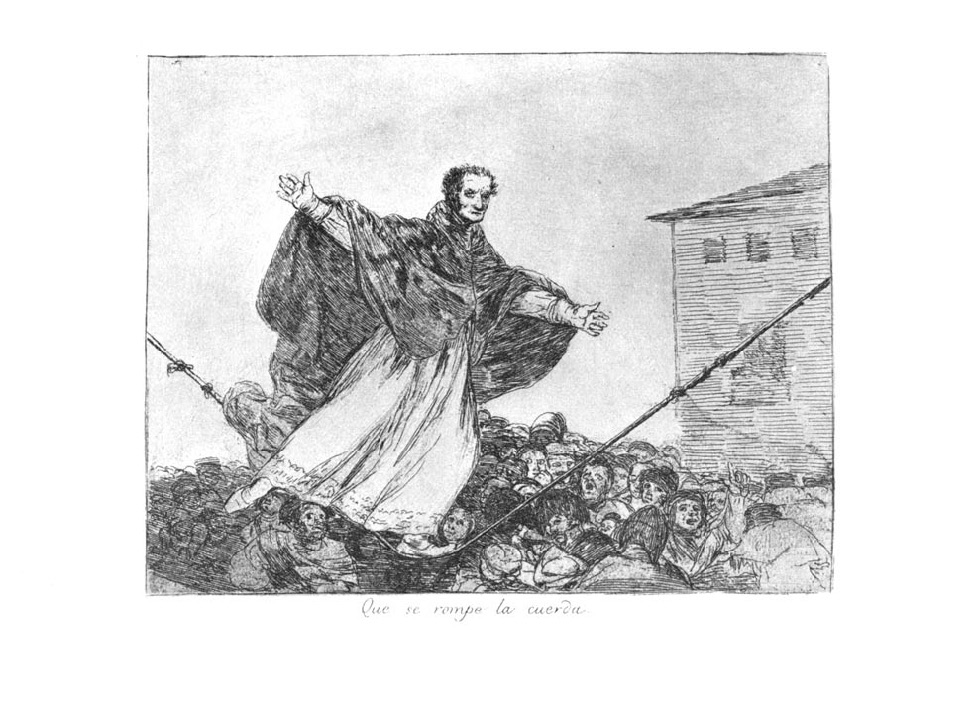
82 prints of Los Desastres de la Guerra by Goya on an aimless Monday evening


Ultimately it was the faces. Just one look at the faces and I knew Goya had touched me deeply. He had made me feel the pain. The physical and mental pain of war. And the sheer futility. A waste.

I knew nothing of Goya before seeing this exhibition. I had ofcourse seen his famous work, The Shootings of May 3rd 1808. But I knew nothing of him, his style, his world. I had read some bits on the Penensular War in War and Peace but that was it. Then one aimless Monday evening I chanced upon an exhibition on a series of war prints by Goya. Goya, a Spaniard, was asked by a Spainish general to witness, and preserve in art, the attrocities being commited by Napoleon's troops in the cities of Zaragoza and Madrid during the Penensular War of 1808-1814. Goya went to the battlfields and the seiges and diligently, often in grave danger or under the protective cover of darkness, sketched out the scenes of agony and human suffering being played out before him. The outcome: a series of 82 prints called Desastres de la Guerra (Disasters of War).
I think each of the 82 prints influenced me immensely. The time I spent amongst them wasn't enough at all. I could look at these engravings over and over again; sometimes looking at Goya's excellent shading technique and his use of dark and light to highlight and conceal, at other times his forceful framing and  composition, and at other times just be lost in those scenes, feeling them, living them. Overwhelming.

The prints themselves are actually etchings/engravings called Aquatints.It think this is a great medium and coupled with Goya's mastery of technique makes for the perfect represtation of such a dark subject. Very effective.

If I was absolutely forced to pick 5 from the 82 prints which influenced me the most, these would be the prints I would select:


I have found a new favourite artist and also images which will always stay in my mind.

Know More:
The exhibition at the Instituo Cervantes - Click here
Goya  and the Desastres de la Guerra
The entire series of Los Desastres de la Guerra, in the correct sepia tone
Penensular War: Spain Vs. Napoleon


Monday, October 26, 2009

Inglourious Basterds (2009)


Inglourious Basterds


In some senses Inglourious Basterds is a typical Quentin Tarantino movie with "Chapter" - based narrative, cinematic nods of acknowledgement to past movies from the same genre and comic relief blended into seemingly ultra-violent settings: (Col Hans Landa's sherlock-holmes-on-hormones calabash pipe compared to the Frenchman monsieur La Padite's rustic little briar-aspirant pipe did break the tension for the entire audience in my hall during the opening scene of Jew search visit). Everything from the title itself to the minor details is inspired but Inglourious Basterdsis definitely worth a watch.


What I liked about Inglourious Basterds is that it gives enough screen time to all the major characters. Though Brad Pitt features most prominently on the posters, to me his character appeared as just one of the many key characters in the movie. Lt. Aldo Raine, the Jew-Red-Indian heritage leader of the Basterds played by Brad Pitt, provides a lot of comic relief and sense of purpose. His southern Tennessee drawl, never ending search for Nazi scalps and matter-of-fact engraving of the Swastika on the foreheads of captured Nazis all help make him the most loved of all the characters with the audience. 
Sample this dialogue between Lt. Aldo Raines and Lt. Archie Hicox


Lt. Aldo Raine: You didn't say the goddamn rendezvous was in a fuckin' basement.
Lt. Archie Hicox: I didn't know.
Lt. Aldo Raine: You said it was in a tavern.
Lt. Archie Hicox: It is a tavern.
Lt. Aldo Raine: Yeah, in a basement. You know, fightin' in a basement offers a lot of difficulties. Number one being, you're fightin' in a basement!


However my personal favourites in Inglourious Basterds are Lt. Archie Hicox, the British German movie industry doctorate holder, played by Michael Fassbender, Bridget Von Hammersmark, the German movie diva played by Diane Kruger and Col Hans Landa, the "Jew Hunter" SS colonel, played by Christoph Waltz. I also liked the acting of the Frenchman Denis Menochet as the French dairy farmer Monsieur La Padite, hiding his Jewish neighbours in his cellar. In fact all the actors in Inglourious Basterds have done really well.


The English subtitles of the many German and French dialogues have been handled extremely well. There are many fast paced dialogues in German which have been executed superbly. Of course most of the cast involved in these is German anyway but it still needs an intelligent director to convert it into great reel time and Quentin Tarantino is more than up to the task here. My two favourite scenes from Inglourious Basterds are: the first opening scene where Col Hans Landa visits Monsieur La Padite and his three very beautiful daughters and the tavern scene involving the three basterds, Bridget Von Hammersmark and the SS Major Hellstrom. In both the scenes a lot about the characters is revealed, the tension slowly builds up, wooden tables are involved (ok that was stupid) and the outcome in each has great impact soon after. Both the scenes have German, French and English. The subtitles have been done well and more importantly the transition from German English and French English and back and forth is amazingly smooth. 


As a film, Inglourious Basterds is acutely aware of its audience being far removed in terms of time from the events of World War 2. Take for instance when the narrator explains the highly combustible nature of the 35mm films of the era of World War 2 and he starts with the words "In those days...". Even the need for the narrator to provide an explanation on this says a lot.Another example of this self-awareness is the pointing out on screen the key Nazi officials using animated arrows. These are not necessarily bad things to do, in fact these help to cut through the chase so to speak and highlight the significance of events immediately. Quentin Tarantino certainly knows how to endear his movies to his audiences. In some sense I would do the same if I was to make such a movie for today's audience...okay now entering the realm of day dreaming.


Films on World War 2 will not go out of style any time soon, they started soon after the outbreak of the Nazi Blitzkrieg in 1939 and haven't run out of steam yet. Apart from Inglourious Basterds, there are at least two Hollywood films on this theme set to be released within the next year (a remake of the 1955 Dambusters and the other being Little Iron Men). Inglourious Basterds will never be in the top rung of great World War 2 films and perhaps if a poll of such great films was to be held a decade from now, Inglourious Basterdsmay not make it into the top 20 but the current popularity of this movie can not be denied.


Where this movie really scores is that it seems to appeal a lot to a newer generation of movie-goers who have never heard of Patton or Tora Tora or The Longest Day or Dirty Dozen or The Eagle Has Landed et al and who couldn't care less about last year's bomb Valkyrie but who can easily sit through a Quentin Tarantino style rendition of almost anything be it a movie on World War 2 or on how a bride extracts sword-blade revenge or on the nuances of selling salted butter in Namibia or whatever. And in this sense Inglourious Basterdsnot only keeps the tradition of World War 2 movies alive but it will perhaps help re-introduce at least some of the above mentioned movies to a newer generation of film buffs. 


And then of course it has the legend of the Bear Jew.........."NEIN NEIN NEIN NEIN NEIN NEIN NEIN NEIN NEIN NEIN"


Post Script: - The black and white Nazi propoganda movie of Joseph Goebbels called the "Nation's Pride", which plays in Shosanna's cinema, was directed by Eli Roth, the character who plays the baseball bat wielding Bear Jew.


Another anachronism I noticed was when Col Hans Landa talks of precluding any chances of being tried by a Jewish court. In 1944 there was no Jewish state and the real possibility of such a state was quite remote. Further the question of a German colonel ending up in a Jewish court would also seems quite remote or non-existent at the time. Hence Landa's comment is anachronistic. However after the formation of Israel some Nazis were tried in "Jewish" courts the most famous such case being the trial of SS Lt.Col. Adolf Eichmann in the 1960s.

Wednesday, September 3, 2008

Google Chrome 0.2 - Google's New Browser


A Layman's Review of Google Chrome 0.2
Or confessions of a decade old Opera user
Or here comes the "IE Killer"

Google has just released the beta version of its new browser called "Chrome". Although this release is not related to history per se or historical in nature I thought I'd jot down a few of my observations on Google Chrome because I've take to it like a fish to water, like Stalin to propaganda, like a gamer to Warcraft, like paparazzi to celebrities,like James Bond to Martini, like governments to corruption,like...

Google Chrome has been built from scratch as a browser meant to be safe, secure, stable, intuitive, fast, and fresh.

What's so different?
(and how do the differences work for me?)

Well not much and quite a lot. To look at Google Chrome is quite similar to some of the new versions of Firefox, Opera, and even IE 8.0. It uses tabs just as they do and it's layout and icons are a little reminiscent of IE 7.

However here are the differences:
1. Google Chrome places the tabs right at the top of the window, where they are easy to reach, and easy to use. It does away with the menu at the top thereby freeing up more space to display the tabs and the web page below the tab.

2. I know I just said it's not too dissimilar to the existing browsers, but yes, Google Chrome's looks are very fresh, clean, uncluttered, and purposeful.


3. Google Chrome uses a multi-process technique to run the show and this is where the greatest difference lies between Google Chrome and other browsers. Other browsers use a single thread - single process system which basically means that the browser can only run one process (in simple terms computation) at a time hence opening a page such as Facebook or Yahoo takes a long time because all the elements on the web page (such as photos, text, clickable boxes, Javascript based items, games, widgets, applications, wall, superwall etc...) are run using that one single process. This also mean that an error / crash / security breach in that process decimates the entire web page and sometimes even the user's system.

However Google Chrome changes all this by assigning each element its own process, thereby making all the elements in a web page load and run faster and also making the whole browser extremely stable and very very secure. Each text item, photo, Javascript aplication etcetera directly interacts with the CPU using its own process and hence a crash / error of one element only affects that particular process (or element) thereby insulating the rest of the web page elements (and their respective processes) and the any other web pages which maybe open from such a crash or error. Similarly any breach / compromise of security in one element does not affect the security of any of the other elements in that web page or any other web pages thereby enhancing the safety levels of the browser and the operating system. Hence fewer or almost no errors and crashes. This blog itself has many widgets and applications and Google Chrome is the only browser which manages to load everything perfectly. Refer to the comic book to understand this in greater detail. More about the comic book at the end of this review. This is not a joke.

4. Google Chrome uses superior memory management for temporary storage of web pages which allows it to avoid memory fragmentation caused by "too much web surfing" thereby enabling a lot more tabs to be used simultaneously and also reduce the "rotting away" of memory which can often make one's browser very slow after some time of heavy duty web usage. Hence the system does not slow down.


5. Google Chrome is built upon something called Gears which is essentially an an open source software. Google hopes that soon all or most of the web will be based on Gears or at least be Gears compliant as this will result in plug-ins becoming safer to use and web pages becomes more efficient at everything. You Tube, Firefox, IE 6, Google Docs, Google Reader, Picasa amongst others are already either based on Gears of Gears compliant. Opera's new version is also Gears compliant. This means the web will become a little more safe and more customised at the same time due to the open source nature of Gears.


Google Chrome's Cool Features


Some of these features are already available in Firefox, Opera, and IE. Google openly admits to being inspired by other existing browsers while determining the features for Google Chrome

Things to look out for in Google Chrome
1. Incognito Window - Google Chrome has a special window in which any link or URL can be opened which would be untraceable once closed. The user's computer and browser will have no cookies or history for the web page opened in the Incognito Window. It is the ultimate form of browser usage privacy.

2. Tab Play and Drag and Drop - Any tab can be pulled out to be opened as a separate window. Any link / image / element on a web page can be dragged onto the tab bar to be opened as a separate tab. Fast and cool, eliminates the need to right click and open in a new tab, almost Mac-like.

3. Task Manager for Browser - Google Chrome includes a task manager for browser which provides memory and CPU usage details for each web page open and for each plug-in being used. This is extemely helpful in tracking down and closing the more memory intense web pages. The End Process button works just like in the Windows's Task Manager. The task manager also provides details for other browsers which may be open at the time and further it provides ever more numbers aptly titled "Stats for Nerds". Very handy, I like it.

4. Domain Name Highlighted - The domain name part in the address bar is highlighted. May not be uselful for many but I do appreciate it.

5. Omnibox - Google Chrome calls the address bar as Omnibox. Typing any word here shows some interesting options in the drop down list; such as search results for the word, previously typed websites names featuring that word, auto complete options for that word etcetera. Make the act of browsing faster. Ripped off from Opera.

6. New Tab Window Features - In Google Chrome a new tab opened will display thumbnails of the 9 most frequently visited websites also with a list of recently closed tabs and a search function right there to search the browser's history (naturally no results will be displayed for sites browsed using the Incognito Window). Makes the browser more intuitive to the user's needs. Ripped off from Opera's Speed Dial feature.

7. Inspect Element - Most Google Chrome user would never use this feature but I'll describe it nevertheless because I do like it. Right click on any element (link, text, image, Javascript applet, button...anything) and click on inspect element. The HTML source code of the page will open and you'll be taken to the relevant code line for that element. The metrics, properties and style for the element are also displayed. This is helpful for me as I know basic HTML and often wonder about which tag has been used to create a particular element. It'll go a long in improving my knowledge of HTML and web pages. This feature is highly recommended for developers. Please note the regular view source feature is also available.

8. Web Page Shortcut - Google Chrome has an application shortcut feature which allows any web page / URL to be created as a shortcut on the computer's desktop, quick launch bar, and start menu. It's a nice feature which allows for a simple double click on the desktop to take you to the web page for which the shortcut has been created.

9. Download Manager - Google Chrome features a regular download manager, the only differences being that downloads initiated from a tab are shown in that particular tab and not in the central download window unlike in Opera and Firefox. However the central download window can be accessed using a shortuct (Ctrl+H). Closing the tab does not interrupt the download though and this is a good feature.

10. Pop Up Management - Pop ups are confined to the tabs of their origin. Clicking and dragging them out of the tab results in their being opened in a new tab. Neat.

11. Sandboxing - Google Chrome uses a process called Sandboxing to determine trust levels and permissions to various elements in web pages. Each tab gets its own sandbox. This segregation into different levels of trust allows for a more secure web experience.

12. Anti-Phishing and Malware - Google Chrome constantly updates it's list of phishing sites and uses this list to conduct verification check of all the URLs typed and opened within the browser.

13. Auto Spell Check - A simple spell check performs spell check on all text typed by the user within Google Chrome. For a natural spellings assassination pro like me this is nothing short of maana from heaven.

14. Open Source - Google Chrome is open source and hence not only can other developers learn from it and use its code for their ideas they can create customised versions of Google Chrome. This feature is Google Chrome's most exciting feature and will take this product from Google's stable far and wide. Google is banking upon the open source nature of Google Chrome and Gears to make the internet more efficient and dynamic.

15. Extensive Testing - Google Chrome has been tested for millions of web pages from a very diverse range thanks to Google's gargantuan data base of the internet. Hence Google Chrome has probably undergone the most extensive and best testing amongst all the browsers recently released.


16. Speed - Google Chrome is much faster than IE or Firefox though Opera might still beat it.

So why don't I name Google Chrome the greatest human invention, what's stopping me?

Well. Google Chrome is a great broswer but there are some shortfalls:

1. No Mouse Gestures - I've been using Opera for close to a decade now and mouse gestures have become a part of my net experience. I love using the left and right mouse button to navigate pages and links without having to push around the mouse. Google admits that in order to ensure safety mouse gestures will never be a part of Google Chrome. Sad. Sniff.

2. Lame Keyboard Shortcuts - Keyboard shortcuts are standard (Ctrl+H for history, Ctrl+T for new tab ...) but nothing close to the superior navigation experience using keyboard keys offered by Opera.

3. High CPU Usage - Because Google Chrome uses multi processes each element on each web page makes a demand individually on the CPU and these multiple origins of CPU usage put a strain on the CPU. Google Chrome will run on a 1.7GHz machine with 256 MB RAM but try running Ms Word, or Paint or along with Google Chrome and you'll see the CPU usage stats immediately shoot up. Google admits that high CPU usage is a characteristic of Google Chrome but it points out to enhanced speed, safety, stability, and security with are obtained in return. For someone like me who runs multiple applications while using the net (MS Excel with Opera with Google Earth with Corel Draw with Google Talk) this is the most major drawback of Google Chrome. I haven't yet tried to run Google Chrome and Google Earth (that other giant guzzler of CPU resource) together but I can anticipate a slow and highly constipated performance from my computer.

4. Spell Check - Well the spell check is great but then the beta version of Google Chrome doesn't allow new words to be added to the dictionary and further the dictionary is not up to date in terms of terminology and technical and corporate brand names. This results in absurdities like the very word Google showing up as a spelling error (recommended changes include goggle, googly, and go ogle :D ). I can't add Google as a word and hence till Google actually updates its dictionary the word "Google" will continue to show up as "go ogle" misspelt.

5. Plug-in errors and Misc drawbacks - Some plug-ins for Facebook, Google Analytics and other sites won't work immediately. Sometimes it does become slightly unstable under certain circumstances. :(
I have also found out that Google Chrome is not as customizable a browser as either Opera or Firefox. For eg - Google Chrome has no option to check / uncheck exit confirmation. Skins...Google Chrome does not offer any skins.

Final Word - Google Chrome a.k.a. IE Killer

Google Chrome will certainly take away most of Internet Explorer's market and hence I have no hesitation in calling it the "IE Killer". I would certainly prefer the beta version of Google Chrome over any version of IE including the recently launched IE 8.0.

If however you are a Firefox or Opera user then weaning you away from Firefox or Opera won't be too easy for Google Chrome. Subsequent versions of Google Chrome will have to come up with better navigation and tweak some other issues before Google Chrome can become your browser of choice. I know that the next version of Google Chrome might replace the special place I have accorded Opera in my heart. However having said that let me still recommend Google Chrome to you as you will find it to be more safe, more stable, and cleaner / neater than either Firefox or Opera.

I would rather use Google Chrome for online financial transactions than any other browser, no second thoughts on that, plus the Incognito Window is a clear winner. I am also very excited about the endless possibilities offered by Google Chrome's open source nature. Google Chrome handles Blogger, Flickr, You Tube etcetera way better than either of IE, Firefox, or Opera. Many pages which were opened by these browsers with errors are loaded flawlessly by Google Chrome.

If you use the net to watch movies, play games, check out live finance data, read PDF files, social network, or anything involving Javascript then surely Google Chrome is your weapon of choice.

Despite its drawbacks Google Chrome is a high quality product but some people expected a lot more from a Google product and wanted to see a "revolution" (as opposed to an "evolution") in the world of browsers. However as far as I am concerned Google has taken some very bold steps with Google Chrome and these should not only leave behind an indelible mark on the browser industry but even change the way we think about browsers themselves.


Now about the comic book. Google has prepared a great comic book to explain everything about Google Chrome and I recommend those interested to take a look at it here. The comic itself is quite enjoyable and an lesson is instructional design.

You can download Google Chrome from here.

Please do let me know about your user experience of Google Chrome.

Thursday, June 12, 2008

Kingdom Of Heaven - What is Jerusalem Worth?

KINGDOM OF HEAVEN


Kingdom of Heaven (released 2005) may be historically inaccurate. It may also be a tad racist (Palestinian villagers living in Palestine for the last few millenia are unable to farm their own Palestininan land until this ironsmith from the French alps comes on the scene and teaches them about irrigation and seed planting and lo and behold we have rivers of milk and honey). It may have bombed at the ticket counters...

But but but...........

It has a great script,
fantastic cinematography,
Eva Green,
ultra accurate costumes (except for a few of the royals and the evil fat man depicted as Templars whereas they were not in reality),
Salah Ud Din / Saladin / Salah Al Din,
wholely reconstructed levithan of a set of Jerusalem with so many amazing details,
Eva Green,
Edward Norton,
beautifully paced battle scenes,
Eva Green,
seige of Jerusalem,
Battle of Hattin,
Eva Green,
beautiful horses,
crusaders,
Eva Green,
Lian Neeson
Ayyubids,
Orlando Bloom actually acting pretty well, honestly I was genuinely surprised,
Eva Green,
trebuchets punctuating the walls of Jerusalem,
maginificent aerial views of the Dome of Rock (the scale and perspective are awesome),
Eva Green,
Battle of Kerak which has been shot so well and the crusader cavalry and later the long shot of King Baldwin riding towards the Crusader stronghold of Kerak,
Jeremy Irons,
Eva Green............
I could see this movie again and again and again.

I can't wait to get my greedy paws on the Director's Cut DVD.

I personally believe there to be scope for a sequel with Richard the Lion Heart and Salah Ud Din battling each other for possession of the Holy Land whilst also exchanging physicians, harem chicks and burito receipes, also though it may not star Eva Green. Sniff....such is life.

This first and last encounter between Balian and Salah Ud Din is my favourite part of the movie, in fact it's one of my favourite dialogues ever. Also it is history relevant for the battle of Jerusalem was yet another milestone in Salah Ud Din's magnificent career but it was also a victory which gave him respect and recognition amongst many muslims for evicting the Christians out of Islam's third holiest site. In many ways it was his greatest military victory.


HERE'S THE SCENE ON YOUTUBE

I really wanted to write a long, detailed and analytical review of this movie but alas I have no time, maybe after I finish reading a bit on Salah Ud Din and the second and third crusades.


Want to know more?

1. Salah Ud Din

Wikipedia (no quality control and prone to change without notice)

Contemporary accounts of Salah Ud Din's "liberation" of Jerusalem (from Internet Medieval Sourcebook - a huge blessing)
Crusader side of the story
Some Muslim accounts

Jewish Virtual Library (a site I respect)

Well written and a bit off the track article by Palden Jenkins

2. Crusades

Catholic encyclopedia on the Crusades

Paul Halsall's Internet Medieval Sourcebook on the Crusades - I love this (this is huge and awesome)

Take a virtual course on the Crusades

3. What is the Kingdom of Heaven and why is this movie called so?

Catholic encyclopedia on the Kingdom of Heaven (not the movie title)

a decent sub page with lots of links on the movie as well as on revelant issues(be mindful I have not explored most of the links on this page, also appears to be a tad vitriolic, so....caveats all around,also let me know what you think of this link !!!)


Eva Green

Thursday, March 6, 2008

Jodhaa Akbar Review


Review of Jodhaa Akbar

Coming of age, Love between a couple after marriage, Religious tolerance
There are some notes at the end of this review of Jodhaa Akbar about how to know more on the historical aspects of Jodhaa Akbar and also on how one can still witness some of this history.


Caution: I am not a film maker. This review of Jodhaa Akbar is an arm-chair review.

Jodhaa Akbar is about the love which blossoms between a husband and a wife after marriage and how it happens . It is about pernicious court intruge (something which the Mughals did better than anybody else in the world). It is about coming of age and taking up responsibilities and making decisions for one's self. It is about religious tolerance and harmony.

Jodhaa Akbar is not about historical accuracy (the producers make it quite clear with a disclaimer to this effect right at the begining). This movie is not about the magnificense of emperor Akbar (even though Abul Fazl would have his readers believe that his glorious benefactor was the Ever Refulgent Light of the Universe even before being born). In an interview director Ashutosh Gowariker was asked if history was central to Jodhaa Akbar and his reply was "It is not central, but it is not incidental either". And this is exactly how one feels during the movie, the historical aspects are in the frame narrative but they are not the main theme of the Jodhaa Akbar.


Timeline - As per my calculations Jodhaa Akbar's core story talks about events from 1559AD to 1562AD and then ends circa 1566AD. This timeline becomes important later on.


Plot summary - The boy king Abdul Fateh Jalal Ud Deen Muhammad finds himself at the helm of the fast receding Mughal Empire in India and he must find a way to put its stars of fortune back on the path of ascendancy. To this end he takes the help of loyal and not so loyal courtiers, crushes rebellions, enters into marriages of alliance, takes cognizance of the ground realities faced by the common folk of his realm, initiates religious tolerance, dances with boys in skirts on his marriage night, and manages to earn the sobriquet "Akbar".
Okay alright, those dancing boys in skirts were in fact the Sufis and probably the warmest part of the movie, but more of that later. Jodhaa Akbar is well made, pleasing to the senses, and sports some good songs.
Let's talk about the good parts:


Good Stuff, ney GREAT STUFF:


1. Hrithik Roshan-
Yes Sir, Jodhaa Akbar will always be counted amongst Hritik Roshan's finest performances, while thankfully Main Prem(s) Ki Diwani Hoon, and Na Tum Jano Na Hum will be relegated under the carpet forever; at least I hope so. Make no mistakes this is the seminal event of his career. This is his English Patient, his Omkara, his Guru; Jodhaa Akbar has changed the way in which even the staunchest of Hritik Roshan’s critics think of him. The respect and admiration he has earned at being able to do justice to a serious role in Jodhaa Akbar will spill over to the whatever other projects he may undertake from now on. Even those who did not understand half of the dialogues due to the slightly Persianised Urdu came out of the cinema halls happy because of Hrithik's role.

"Ay, Every Inch a King" (sans sacrasm)
Hrithik looks and acts royal. He moves and gestures with regal dignity and blue blood purpose (does that sentence mean anything???). He may never be Emperor Akbar in the minds of some of the more puritanical aficionados of history but he looks, acts, feels emperor-like.
One of my personal grudges with Jodhaa Akbar has always been that there is a lot of difference between the physique of the 5feet 11 inches-muscled-to-the-hilt, chiseled-for-the-Greek-Pantheon Hrithik Roshan and that of the character he plays in this movie, the 5feet 4inches odd barel-chested-stocky-mole-sporting-mongoloid-round faced- frame of emperor Akbar. The Lord knows Prithiviraj Kapoor is always going to remain in my mind as the pot bellied Akbar just as any mention of Moses, Judah Ben Hur or any Israelite for that matter conjures up a torrential flood of Biblical proportions in the form of a bearded Charles Heston, clothed in coarse fabric, flinging down God's commandments engraved in stone, from far atop a mountain on the unbelievers, with dark skies and lightening in the background....okay I went too far I know. Sorry. But you get the idea and if you don't here's them photos an'all to help y'all:
= Zill-e-Ilahi, Badshah Salaamat, Jahanpanha-e-Aalm


= Sex on Toast

One look at the excited and ultra positive reception Hrithik has received in the minds of movie goers and you realise immediately that Hrithik has created and cemmented a new youthfull image of Akbar. And another things is that the younger generations seem to identify more closely with Hrithik Akabr than Prithivi Akbar.

Urdu
Jodhaa Akbar makes liberal use of slightly Persianised Urdu words and Hrithik's Urdu/Persian pronunciation is perfect. Speakers of Hindustani and Urdu would know that in these languages there is a distinction between the sounds "g" and "gh" as in "gana" (song) and "ghareeb" (poor) and also the same is the case with "k" and "q" as in "kaam" (work/task) and "qalam" (pen) and Hrithik Akbar hits both the "gh" and "q" perfectly. Even his intonation is very purposeful. "Ma Shaa Allah Roshan Sahab" is all I can say for his Urdu diction. Me impressed.


Acting
Powerful, gentle, ecstatic, sad...all done well. There are shades of his earlier movies in many dialogues but he's doing fine. Also look at intro paragraph above.


2. Camera Work -
Jodhaa Akbar boasts of some pretty good camera work throughout the movie. The technical standards of Indian cinemas keep rising with every new production and Jodhaa Akbar has raised bar a bit further in this respect.


Angles
Angles are utilized to great effect; in fact the wide angles have been used with great frequency often to show not only the character but also to highlight the work done by the art direction team. This adds to the "feel" of the times immensely though on one or two occasions I felt that close ups of the actors would have been better.
The camera angles used in the long shots for all the battle scenes, be they ultra tele-shots of the cavalry approaching the battle ground or top down shots of the troop formations or even shots of infantry running in to clash with the opposition all have been executed with a certain degree of mastery. Though on one occasion somebody did remark that it all looked like screenshots from Age of Empires and that is the honest truth as far as the battle views from top of the hills are concerned but let it not distract us too much from the fact that the work is well done. The hand to hand combat scene between Akbar and Shareef Ud Deen is top notch even if it seems to borrow heavily from Troy in the first few moments.

Use of Screens
Throughout the movie one can experience a sense of mystery and excitement created by use of curtains, marble screens, fine translucent muslins, and jaali work objects placed between the camera and the actor in question. And all such shots add significantly to the experience, though bad lighting or wrong positioning could have easily ruined most of these shots but then they've pulled it off well.


Must see scenes:
(some of these can be seen on the official website http://www.jodhaaakbar.com/, check under trailors.)
(Not in any order of precendence)


1. Akbar Hrithik standing next to tree in Mo'eein Ud Deen Chisti's dargah - This will always be one of my favourite scenes ever. This is the last shot of this scene. Low camera angle showing a larger than life Akbar (do I hear Orson Welles chuckling at back). Emperor Akbar in simple clothes with a pilgrim's scarf on his head, standing in front of a balding tree with white ground and a clear blue sky framing most of the visible background. Even the opening shot of this scene which shows Akbar in supplication at the dargah is a pretty nice shot especially the way the camera comes in...


2. Morning shot of Jodhaa Aish coming out of her room onto the balcony of Amer fort for the last time with pigeons on the balcony. The soft light with not even a hint of Sunlight is perfect. Great dawn shot. Another good shot of her with pigeons is when she is sitting with the pigeons in Amer on a huge cushion looking lost and lonely( after she has traversed over the Aravallis from Agra back to Amer in a huff).


3. Jodhaa Aish in highly colorful translucent veils especially the yellow coloured veil during Dushera, red coloured veil on marriage night, red coloured veil while serving Rajput food to the inner clique of the court, and green coloured veil right at the end while seated with Akbar. Much of the movies colour riot is in part due to Aishwarya's costumes. Though it's not as great a colour riot as Paheli.

4. Choreography of the song Azeem O Shaan Shehenshah. Circles upon circles upon circles involving hundreds of dancers and they've done it beautifully.


5. Sword fight between Akbar Hrithik and Jodhaa Aish. Ah the chemistry there is close to perfect. In fact it's through scenes like this one that the true romantic aspects of the movie get highlighted. This is where their love blossoms after their marriage. One of my favourite dialogues also takes place here, when Jodhaa Aish almost gains the upper hand over Akbar Hrithik during the sword fight and then Akbar Hrithik is quick to remind her "Malika-i-Hindustan, yeh mat bhooliye ke hum aapke suhag hai."


6. Morning sunrays bouncing off bejeweled mirror in the Khwaab Gah


7. Khawaja Mere Khawaja
See below :)


3. Khawaja Mere Khawaja
The zenith of Jodhaa Akbar

(To see the Correct Lyrics for Khawaja Mere Khawja click here . Most of lyrics available onlin seem to be incorrect. I have given the lyrics in transliterated English as well as in Urdu. I have also given the meaning of the song and some of the Sufi terms used in Khawaja Mere Khawaja.)

Hmm...What can one say? The beauty of this song itself is ineffable. Mesmerizing, touching, deep, soothing, connecting, divine...these are some of the words you may hear when talk about this song. One has to hear it to know what I am talking about. I usually listen to this song on a loop atleast 30 to 40 times in a go. Such is its salubrious effect. It is what I would call as a great Sufi song. The lyrics are sublime, peaceful, and establish camp in your heart before you can say "Walla A R Rehman Sahab". He has done a fantastic job. Khawaja Mere Khawaja will forever be my favourite A R Rehman song. I don’t want to write too much about it because I am sure most would have experienced what I am talking about. And make sure you check out the instrumental version of Khawaja Mere Khawaja which can hold its own in front of the best instrumental compositions ever.
The choreography is good, the dresses may not be historically accurate (leaning more towards the whirling dervishes of Konya,Turkey than the Chistis of Ajmer) but never the less the songs has been shot well. I loved the part when Akbar Hrithik gets up at the end and starts whirling with the Sufi dervishes and I believe many people felt good about this part. It is at that moment that the viewers almost fall in love with the spirituality of Akbar. This really helps bring Akbar to life and to paraphrase Abul Fazl "makes the divine light of the Emperor's love enter our hearts".
Just a little something I would like to add about this song. I think it's a type of Manqabat i Khawaja. Traditionally Sufi Sama' and Qawwali programs have had a sort of warrant of precedence which starts with a Hamad (praise to God), then Na't (praise for the Prophet Muhammad), then Manqabat (praise for Ali) and then Manqabat i Khwaja (praise for the founder of the concerned sufi order). In this case the founder of the Chistiya order in Hindustan being Hazrat Khawaja Mo'een Ud Deen Chisti, the Manqabat is for him and one can hear him being addressed as "Ghareeb Nawaz" (a very very popular epitaph of Hazrat Khawaja Mo'een Ud Deen Chisti). Another very popular epitaph is "Mehbob i Illahi" for Hazart Nizam Ud Deen Auliya one of the greatest Pirs of the Chistiya order.


4. Costumes and Jewllery
The costumes for Akbar (Hrithik Roshan) are the best. Although the costumes for Jodhaa (Aishwarya Rai Bachchan) come second, they are a distant second. Sure Akbar does repeat a couple of his costumes but truly such rich work, amazing colours, intricate jacquards, merging embroidery (in the words of a vendor of marriage lenghas from Karol Bagh his clothes have "aaal o'er umboideree jaal"). Best Jewellery obviously for Jodhaa Aish. I loved the peacock necklass she wears in the kitchen scene for the Rajputi Dawat.

Malika –e-Hindustaan all ready to fly off on her honeymoon. Wonder how she’ll negotiate airport security though, hmmmm….


And while speaking of costumes there is a glaring error which I would like to point out. Sonu Sood who plays the role of Suja Mal has been made to don the most ill fitting costumes I have ever seen in a movie. The ungainly creases and bulbous folds all over his costumes give a telling picture of how corners have been cut while making Jodhaa Akbar.
Hrithik Akbar's armour and also most of the horse amour was reasonably authentic.
5. Support Cast
Well this one’s a sitter as far as I am considered. The best supporting role has been played by Ila Arun as Maham Anga. I have been reading books on Akbar for more than a decade now and by now I have a fairly detailed mental picture of Maham Anga. Ila Arun is that very picture. Cunning, scheming, plotting….She’s the Prince of Machiavelli’s Prince. The Mughals were probably the best at Harem intrigue and Maham Anga was the best Mughal in this respect. It took Akbar the Great to bring about the downfall of Maham Anga and Jodhaa Akabr depicts th Ila Arun should definitely be nominated for her portrayal of Maham Anga.
Sonu Sood comes second but he is a distant second. Next to Maham Anga it is Suja Mal who is the most important support character and Sonu Sood should have been metted out more professional treatment. These ill fitting costumes are visible even in the promo shots available on the official site of Jodhaa Akbar.
On the other hand tied with Sonu Sood for second place in the supporting cast is the towering personality of Niktin Dheer who lends his leviathan of a frame to the role of Shareef Ud Deen Hussain. This giant even dwarfs Hrithik Akbar’s presence while both are in the same shot and the hand to hand combat sequence between these two at the end has to be one of the best filmed in Indian cinema. I hope to see more of him in the future.

6. History
Jodhaa Akbar, despite director Ashutosh Gowariker’s claim of history not being central to the movie, has a largely accurate chronological sequence of events. Almost all of the events which one may come across in any standard biography of Akbar till the date of 1562-1564 AD have been depicted in Jodhaa Akbar. Accession of Akbar at the age of 13 years, the Second Battle of Panipat, the forced exile of Bairam Khan to Mecca, Akbar’s visit to Ajmer Shareef (though a very famous incident of Akbar single-handedly slaying a tigress protecting her cubs on his return journey from the Sufi shrine does not find mention), elephant fights, Akbar’s marriage with the daughter of the Rajput king of Amer Bhar Mal (duh...), assassination of Atka Khan by Adham Khan, execution of Adham Khan and Maham Anga’s subsequent death, abolition of the Jizya (the religious tax imposed on the Hindus) by Akbar in early 1564, all find mention in the Jodhaa Akabr. Well done Mr Gowariker.
7. Jash Ne Bahaara
Nice humable tune which absolutely refuses to vacate one's mind and indeed does establish a permanent presence in one's heart.

What’s Not So Great (in no particular order of preference) :

1. Historical Inaccuracies

There are many and they don’t really matter as it’s a love story first and a historical movie second; some of the more glaring ones are listed below:

1. Akbar was NOT assigned the sobriquet Akbar by the people of Agra. There is ample documentary evidence to believe that he was called Akbar from a very early age if not from birth.

2. I have not as yet come across any references to a near fatal assassination attempt on Akbar circa 1564.
15th of Sept 2008 - I have recently come across a reference to an assassination attempt on Akbar in an old book on Delhi's history published in the 1950s. The attempt was made in 1566 in the vicinity of Khair Manzil (a madrasa founded by Maham Anga) near Purana Qila in Delhi (not Agra, hence the movie gets this wrong). The assassin was a Central Asian archer employed by Shareef Ud Deen Hussain and he managed to shoot Akbar in his shoulder, though Akbar, as we all know, survived.
Hence this is not a historical inaccuracy at all and I humbly take back my objection :)

3. There was no significant rebellion (as shown to be headed by Shareef Ud Deen Hussain in Jodhaa Akbar) circa 1564- 1565. In fact the first such rebellion was the Uzbek rebellion in favour of Akbar’s half brother Muhammad Hakim in 1564 followed by two more Uzbek rebellions in subsequent years.

4. Jodhaa – though many of us have Jodhaa Bai as the name of Akbar’s first Rajput wife (and Jahangir’s mother) in our minds and the ASI insists on calling a part of Fateh Pur Sikri as the “Palace of Jodhaa Bai” yet no historian of any significance would use the name Jodhaa for this person. I wonder how much K. Asif’s Mughal- e- Azam has to do with creating this impression in our collective imagination. The controversy may seem a bit senseless to some but it holds immense significance to the Rajputs and hence the ban on the Jodhaa Akbar in Rajisthan and Uttar Pradesh.


5. Rajput honour – There has been quite a lot of criticism that the Rajputs have been shown in a very poor light. Some say that it is unfathomable for a Rajput queen (Jodhaa’s mother) to suggest anything dishonouring the word of husband. Further she is shown suggesting suicide as a course of action to her daughter though this would lead to dishonouring her own kingdom (Amer) and would go contra the safety and security of her own subjects. I do not feel myself to be adequately equipped to reply to this criticism and although a case supporting Ashutosh Gowariker’s interpretation can be made by citing the logic of ‘exceptions always been there’ yet it is not very easy to explain this away.

6. The narration in the beginning of Jodhaa Akbar mentions 1450 AD as the date of commencement of Mughal conquest of Hindustan. By no stretch of imagination is this date correct. If Babur is taken to be the founder of the Mughal dynasty in India then the date has to be 1505 AD at the earliest as that is the year of Babur’s first incursion into India. If however Timur is taken to be founder the date has to be 1398-1399 AD and no later than that. In either case the date of 1450 AD is wrong.


7. Bairam Khan’s very active rebellion against his ward, Akbar, is not shown, instead a possible rebellion by him is only hinted at in the movie.

2. Movie Length and story pace – Though almost everybody has been complaining of the extraordinary length and very slow pace of the Jodhaa Akbar (run time is approximately 3 and a half hours) personally I found the movie to be quite well paced and I cannot see a shorter run time doing justice to the story.

3. Language – Again as above a lot of people have had a problem with the level and frequency of Urdu words employed in Jodhaa Akbar and yet I only see the language as adding to the ambience and “feel” of the setting. To be fair Jodhaa Akbar does sport a lot of “massarrat, mukhaalfat, and mashaqqat” et al but then it’s nothing compared to the very very highly Persianised Urdu used in Razia Sultan (in fact Hema Malini did a pretty decent job with her Urdu diction in that one).

4. Aishwarya Rai – Well she’s okay in Jodhaa’s role, but then that’s about it, she’s okay. Nothing more. Bit of a Guru hangover there perhaps.


5. Suja Mal’s clothes – already discussed in the heading Costumes and Jewellery. Really shoddy work there.

6. Some of the close ups in the shots of the Second Battle of Panipat are poor quality.


7. Gowariker’s Akbar’s personality a shadow of the Akbar of history – Akbar’s penchant for the arts, culture, architecture, the sciences, invention etcetera do not find any mention at all in Jodhaa Akabr, although he had acquired a taste for these at a very early age. This in my mind distances Hrithik Akbar from the real Akbar the most, even more than the disparity in the physical features of the two. Thankfully his religious and spiritual proclivities have been depicted very well throughout Jodhaa Akbar.


The Navratnas / Navratnas Controversy

Finally I must write a little on the criticism of the absence of the Navratnas / Navratanas of Akbar’s court as shown in Jodhaa Akabr. To me this objection seems very naive. The Navratnas were the 9 jewels of Akbar’s court who together with Akbar have long been a firmly established part of Indian folklore. There is criticism to the effect that Jodhaa Akbar does not show any of the Navratanas baring Raja Toda Mal (Akbar’s finance minister played a tad insipidly by Pramod Moutho). However this is where the timeline becomes so important. The story of Jodhaa Akbar ends around 1564 AD and one needs to ask the question “exactly how many of the Navratnas had become a part of the Akbar’s court by 1564-1565AD?” The answer is “not many”. Ashutosh Gowariker could not have shown most of the Navratnas, even if he wanted to, as most of them were not yet a part of the top political echelon of the Mughal court. One must remember that emperor Akbar the Great (along with Ashoka) is the only ruler of India to have been given the title “Great.” One must also remember that Akbar ruled till 1605 AD, that’s almost 50 years of reigning over Hindustan and Jodhaa Akbar shows only about 7 to 9 years of that long drawn out period so how much of the magnificence of Akbar’s life and court can one show in a movie depicting only 1/5th of the total time of his reign. Exactly how much of the “greatness” of emperor Akbar is the director expected to stuff into the script of Jodhaa Akbar? This movie is about the very early political events of Akbar’s career and the love between Jodhaa and Akbar and not about the length and breadth of the vast ocean that was his life.

This movie is worth a watch. Infact in my case it's not worth a watch, not two watches, not even three watches; to satisfy my own viewing-lust and appease certains friends and relatives I will end up watching it alteast four times. Yeah that's right 4 times.

Why did I give 4 and a 1/2 stars and not 5? Because the historian in me refuses to be completely mollified.


Bottom Line: One can see Jodhaa Akbar atleast once, if not for Hritik, if not for the technical mastery....then at least for Khwaja.


How do I get to know more about these guys? I want to read.


If like me movies can sometimes induce you to know about the subject or at least this is what has happened in the case of Jodhaa Akbar then you can refer to the following material to learn about Emperor Akbar, the Mughals, and the history of the time. There are plenty of resources and here is a very brief list of some of them (all in English):


1. Wikipedia on Akbar – A good place to start but lacks adequate quality control and prone to changes without notice
2. Richard Von Garbe – A short but very nice and very panoramic booklet on the life of AKbar written in 1909 but still relevant today. Worth a read. Download for free.
3. Emperors of the Peacock Throne A Early – A great read about the rise and fall of the Mughals with a large portion dedicated to the life of Akbar. Written more like a novel than a history text
4. Peacock Throne Wardemar Hansen – Probably one of the best history books ever. Focuses on the period from the last stages of Akbar’s rule down to Aurangzeb. Rife with tales of harem intrigue, incest, power play, chicanery, blood sugar sex magik...an UNPUTDOWNABLE TABLOID OF THE MUGHAL RULE.
5. Jadunath Sarkar’s Fall of the Mughal Empire – The definitive work on this topic. Approaches epic proportions.


If you would like to discuss more on these resources or would like to know about more advanced resources then please email me. I would love to be of help to you.

Where are they now? I want to see.
One can witness some of the history of the movie Jodhaa Akbar with quite a bit of the glory and dazzle intact. Some of the places mentioned below are actually related to events depicted in Jodhaa Akbar.

1. Humayun’s Tomb Delhi – Akbar got it built for his father Humayu at the behest of his mother Hamida Bano Begum (played Punam Sinha ie Ms Satrughan Sinha in Jodhaa Akbar). Many say that it is the proto-type to the Taj Mahal and I would recommend it to all. The tomb and the garden settings around it are the best in Delhi. I could write pages on it.
2. Adham Khan’s Tomb Delhi – Both Adham Khan and Maham Anga are said to be buried here though there is only one cenotaph inside. The tomb itself is in a dilapidated condition and the walls are blanket by graffiti hewed in them by stupid people. But But But why it is important is because it is one of the most unique Mughal tombs as the design is more Lodi-Sayyid-Afghan than Mughal. It’s octagonal a la Isa Khan’s tomb in the Humayun’s Tomb complex and looks a bit like She Shah Suri’s tomb in Sasaram. Perhaps Akbar was so angry at Adham Khan that even after having him executed, by having him thrown him off the roof twice, he did not allow Mughal ideals of architectural perfection to grace Adham Khan’s grave. Also there is a disturbing lack of the ubiquitous Persian Char Bagh found in almost every Mughal tomb.
3. Red Fort Agra - A most beautiful fort. Must see. Most of the movie Jodhaa Akbar features scene setting in this very fort and the Khawb Gah with the huge golden mirror, Bawarchee Khana, Diwan I Aam etcetera can still be seen by visitors.
4. Fateh Pur Sikri –The Mughal enigma. Even contemporary historical records don’t shed much light on why it was abandoned and there are many versions of the story.What is termed as Jodha Bai’s Palace is housed inside this fort as are some of the other well renowned structures such as Buland Darwaza, Salim Chisti’s tomb, Ibadat Khana, Anup Talao, One of my favourite saying is inscribed on the Buland Darwaza and God Wiling I will post something on it very soon.
5. Amer Fort Jaipur – Just like the rest of the monuments in this list, Amer doesn’t need any introductions. Make sure you take the elephant ride from the foot of the hill on which Amer is built all way up into the main central square inside the fort on the top of the hill. The fortified walls which run along the surrounding hills from miles are so beautiful to look at !!! Jodhaa’s scenes in Amer are really well shot. See here.